1920s Vintage
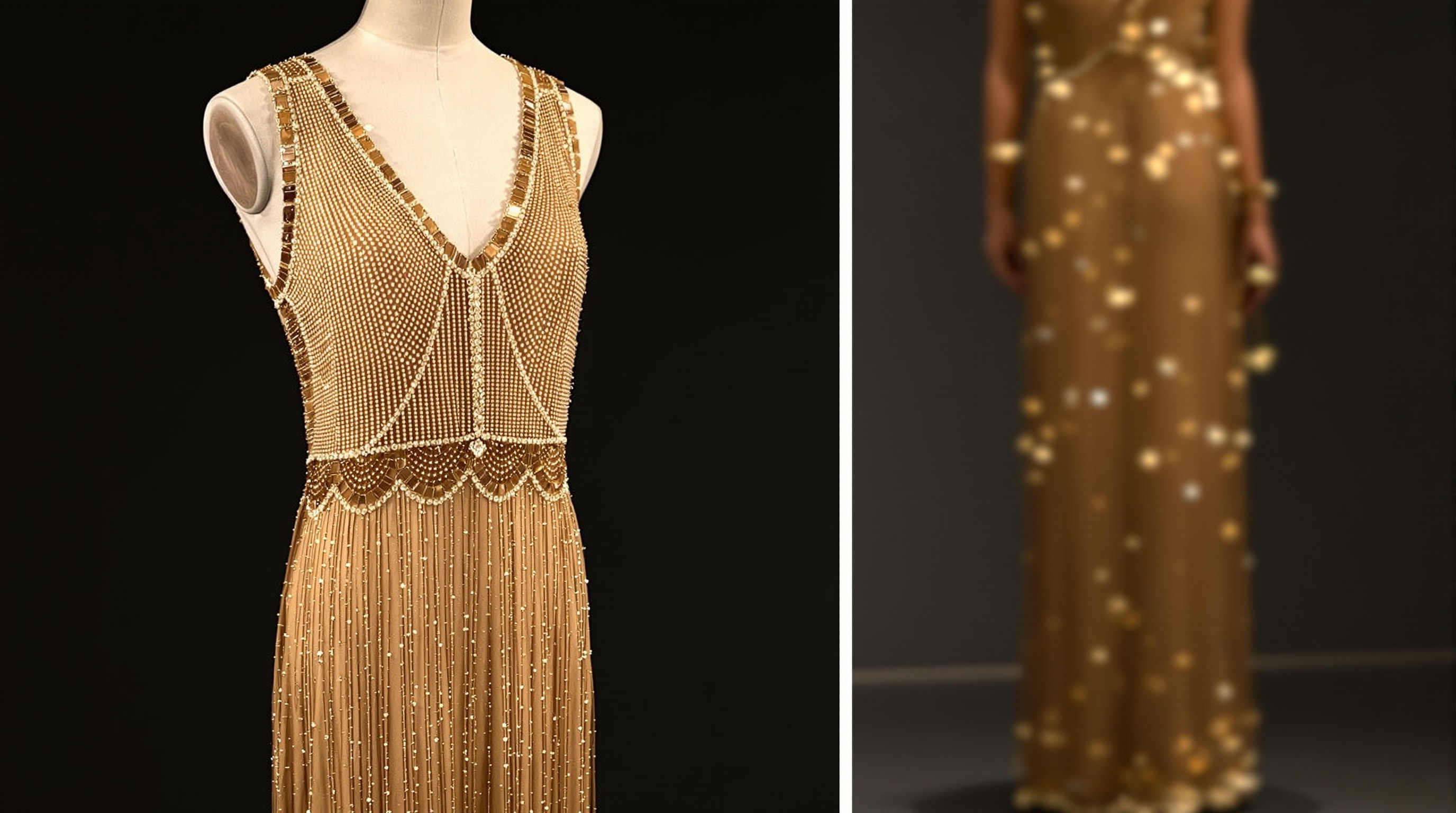
The 1920s produce the first genuinely unstructured garments in the collection. The waist drops to the hip or disappears, the bodice hangs from the shoulders rather than fitting the torso, and the corsetry that had shaped every previous era is either abandoned or reduced to a flattening undergarment. It is a complete break, and it is visible from across a room.
The line
The dress becomes a tube. Fullness, where it exists, is at the hem rather than the waist, and it is achieved with godets, panels, tiers or handkerchief points rather than with gathering. The natural waist is not merely ignored but actively suppressed; a seam at the hip, or a sash tied there, is the signature detail.
Hems move a great deal across the decade and are worth watching: relatively long at the start, rising to their shortest around 1926–27, and dropping again markedly by 1929. Uneven hems are common throughout — longer at the back, pointed, or with a floating overlayer longer than the underdress.
Surface over structure
With the structure gone, all visual interest moves to the surface. This is the decade of dense allover beadwork, sequins, metallic lamé, fringe, and heavy embroidery on light ground fabrics — chiffon, georgette, net and lightweight silk. Beading is frequently worked directly onto the ground rather than onto an applied panel, and on the best pieces it is worked by hand in patterns that follow the cut.
Two other surface treatments date well: fringe, silk or beaded, set in horizontal bands; and lamé woven with genuine metal-wrapped threads, which is quite different in weight and behaviour from later metallised plastic yarns.
Bridal
Bridal follows the same line — pale, straight, low-waisted, often with a long detachable train falling from the shoulder or hip rather than the waist. Lace is used heavily, and the cap-style headdress worn low on the forehead with a long veil is so characteristic that it dates photographs on its own. Bridal of this decade is frequently ankle-length or shorter rather than full-length. The bridal reference sets it in sequence.
The fragility problem
This is the most fragile decade in the collection, and the reason is structural rather than accidental. Heavy glass beading was applied to chiffon and net that were never engineered to carry it. Under its own weight, over decades, the beadwork saws through its own ground fabric. Hanging a beaded 1920s dress accelerates this enormously — the entire mass of the beading pulls on the shoulder seams — and it is the single most common way these garments are destroyed in domestic storage.
Look for beads that have migrated out of pattern, for fine slits radiating along a bead line, and for a ground that feels papery when supported on the flat of the hand. Metal-thread lamé presents a second problem: the metal oxidises, becomes brittle and abrasive, and cuts the fibres it is woven against. Neither is reversible.
Store flat, interleaved and supported — never on a hanger. The full recommendations are under care and storage, and fibre identification under textiles.
Dating notes
- Waist seam at the hip, or no waist seam at all.
- No interior boning and no fitted foundation.
- Closures are hooks, snaps or a short side placket. A metal zip suggests the 1930s or later.
- Ground fabrics are light; heavy structured fabric is out of period.
- Uneven or pointed hems.
For dated comparison the Kyoto Costume Institute and The Museum at FIT both hold deep 1920s holdings.
Nothing described here is for sale, in stock, or available to order.