Vintage Textiles
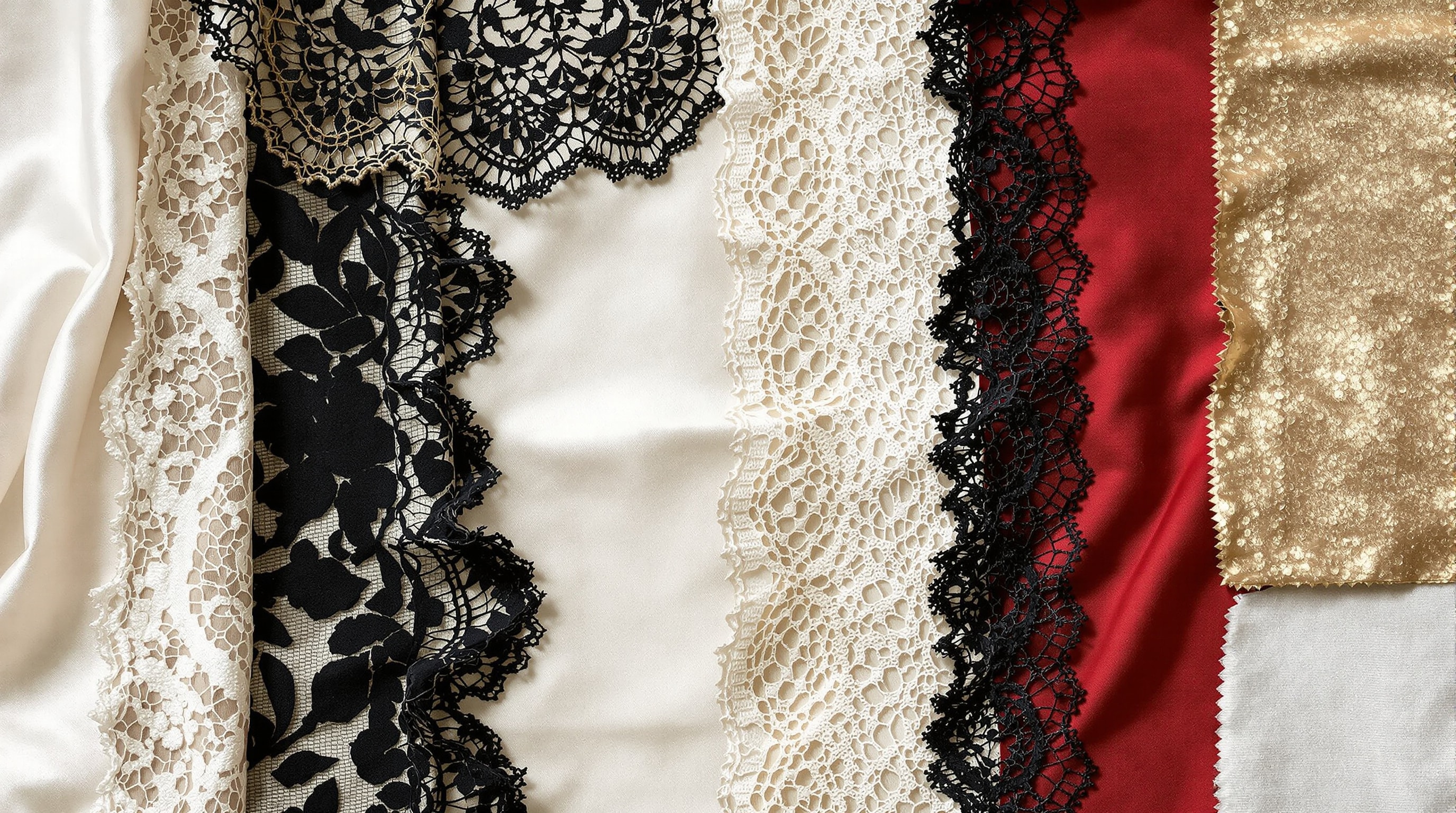
Cloth dates a garment more reliably than style does. Styles are revived constantly — every decade since the 1960s has produced its own version of a 1920s dress — but a fibre cannot be made before it was invented, and a finishing process leaves evidence that survives the garment. This page covers the materials that recur across the collection and how to tell them apart by hand.
Natural fibres
Silk is the dominant fibre of the earlier part of the period. It is warm to the touch, takes dye brilliantly, and has a characteristic dry rustle in taffeta weights known as scroop. Its critical weakness is chemical: from the late nineteenth century until roughly the 1930s, silk was routinely weighted with metallic salts to add body and disguise thin cloth. Weighted silk degrades from within and eventually shatters into fine vertical splits along the grain. Nothing arrests it. It is the single most common terminal fault in the collection.
Cotton appears throughout, at its finest in the pre-1920 period — lawn, batiste, voile and organdy of a fineness that is now difficult to source. Cotton is strong, washes well and survives better than almost anything else, which is why Edwardian whitework dresses turn up in wearable condition far more often than silk gowns of the same date.
Linen is cool, heavy for its thickness, creases sharply and shows characteristic slubs in the yarn. It is durable but weakens badly at fold lines, so long-stored linen frequently fails exactly where it was folded.
Wool carries the daywear and outerwear side of the collection. Its enemy is not chemistry but insects — see care and storage.
Manufactured fibres, and what they date
This is where identification becomes genuinely useful, because each fibre gives a hard earliest-possible date:
- Rayon (viscose) is in commercial dress use from the 1920s and is ubiquitous by the 1940s, when it substituted for scarce silk. It drapes beautifully, feels cool, and is much weaker wet than dry — which is why 1940s rayon crepe so often shows distortion and water-marking.
- Acetate appears alongside it and is common in linings. It is crisper than rayon, and it dissolves in acetone: a nail-varnish remover test on a hidden thread is diagnostic, and is also a warning about solvent cleaning.
- Nylon is a post-1940 fibre, in general dress use from the 1950s. Early nylon net is stiff and yellows badly.
- Polyester means the 1960s at the earliest and is dominant by the 1970s. It does not crease, does not breathe, and is essentially indestructible — its presence in a garment claimed to be pre-war settles the matter.
- Lurex and similar metallised plastic yarns are a 1950s-onward marker, and are distinct from the genuine metal-wrapped threads of earlier lamé, which tarnish and become brittle.
A burn test on a single thread taken from a seam allowance is the traditional identification method and remains the most reliable one available without a laboratory. Protein fibres — silk and wool — smell of burning hair and leave a crushable black bead. Cellulose fibres — cotton, linen, rayon — smell of burning paper and leave soft grey ash. Thermoplastics — nylon, polyester, acetate — melt away from the flame and leave a hard bead that cannot be crushed. Take the thread from somewhere invisible, and never test a garment you would not be willing to mark.
Separate the layers
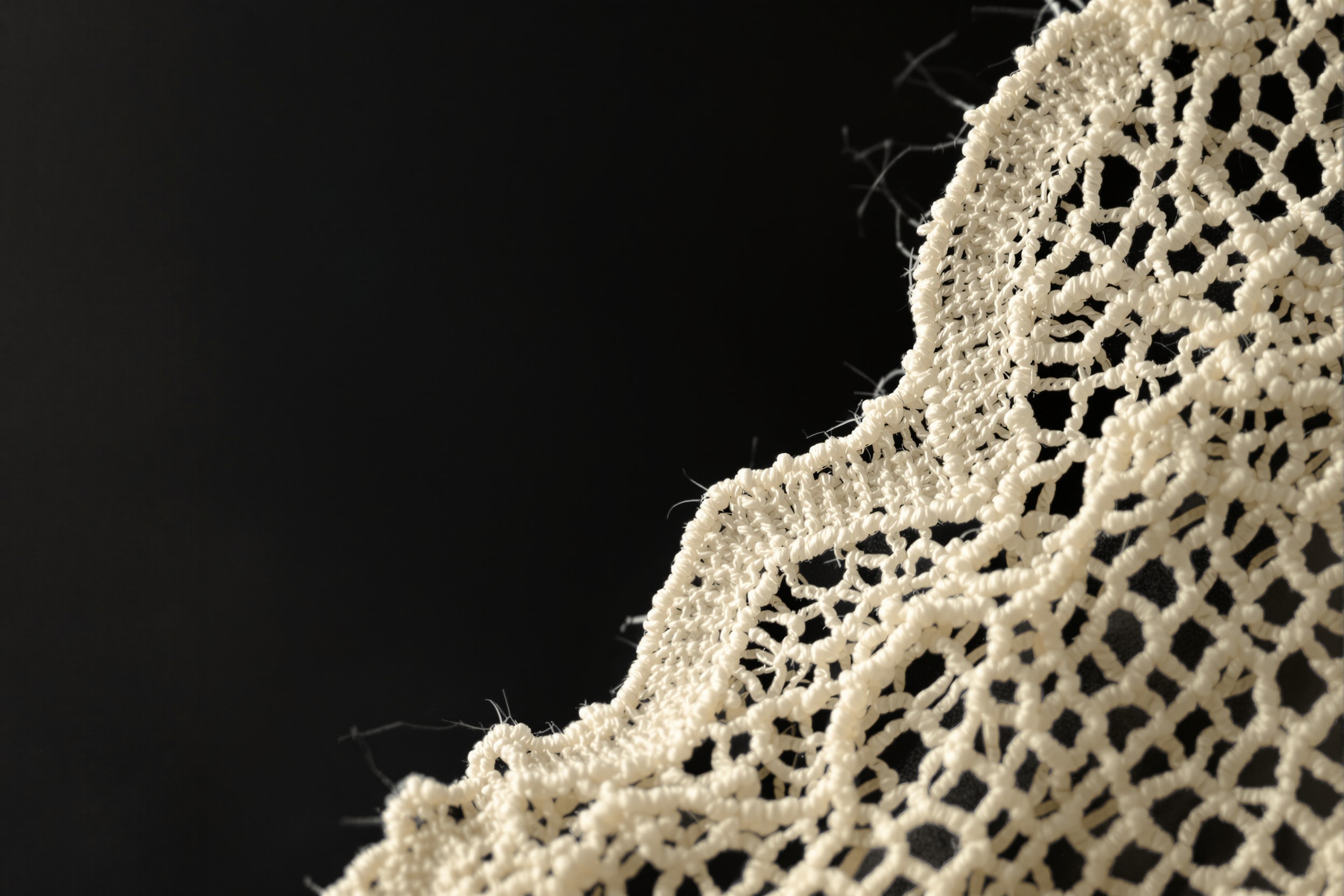
A dress is an assembly of materials, not a single fabric sample. Consider the outer cloth, lining, interlining and trim separately. The lining may have been replaced while the shell remained intact, and a repair patch can introduce another fiber altogether. An observation about one layer should stay attached to that layer. A smooth synthetic lining, for example, describes the lining; it does not automatically establish the composition or age of the fabric above it.
Look at an accessible seam allowance as well as the face. The reverse shows how yarns cross, while a lining can conceal them completely. Describe what is visible before settling on a name: sheen, rib, surface texture, yarn direction and the relationship between motif and ground. Keep fiber and weave as separate questions. Two satin surfaces can have different fibers, and one fiber can appear in several weaves. If a label names only the outer fabric, leave the other layers unidentified until there is evidence for them. An uncertain identification is more useful than a confident guess.
Weaves and finishes
- Satin is a weave, not a fibre — long floats on the face give the sheen. It can be silk, rayon or polyester, and identifying which matters far more than the weave name.
- Crepe takes its grainy surface from highly twisted yarn. Silk crepe and rayon crepe behave very differently in water.
- Taffeta is a crisp plain weave that rustles. Historically a prime site for weighting.
- Faille and ottoman are ribbed weaves that hold sculptural shape — hence their dominance in the 1960s.
- Organdy is sheer cotton given permanent crispness by an acid finish; organza is its silk or synthetic equivalent.
- Peau de soie is a heavy, dull-faced satin, characteristic of mid-century formalwear.
Lace
Lace identification is a discipline in itself, but a few distinctions carry most of the practical weight. Handmade lace divides into needle lace, built with a needle and thread from a single thread structure, and bobbin lace, worked with many threads on a pillow. Both show slight irregularity and a continuous, integral ground. Machine lace arrives in quantity in the nineteenth century and is identifiable by exact repeats and by a mechanically uniform net ground.
Among the named types that recur most: Chantilly, fine, dark and with a delicate outlined floral design on a net ground; Alençon, with a raised cord outlining the motif; Guipure, heavy motifs joined by bars with no net ground at all; Brussels, with separately made motifs applied to a ground; and broderie anglaise, which is not lace but cutwork embroidery on cotton, and belongs firmly to the Edwardian and 1970s parts of the collection.
The most useful shortcut on any piece of lace is to look at the ground. A ground that is perfectly regular is machine-made; a ground with small, unrepeating irregularities is not. Museum textile departments publish the best comparative images available — the Victoria and Albert Museum holds a particularly deep lace collection with detailed catalogue records.
Further reading
The The Textile Museum publishes free technical notes on fibre identification and textile deterioration, and the Costume Society of America maintains scholarship on dress history and material culture. For what these materials mean in practice when a garment is being assessed, see assessing a vintage wedding dress.
No textile or garment described here is for sale, in stock, or available to order.