1940s Vintage
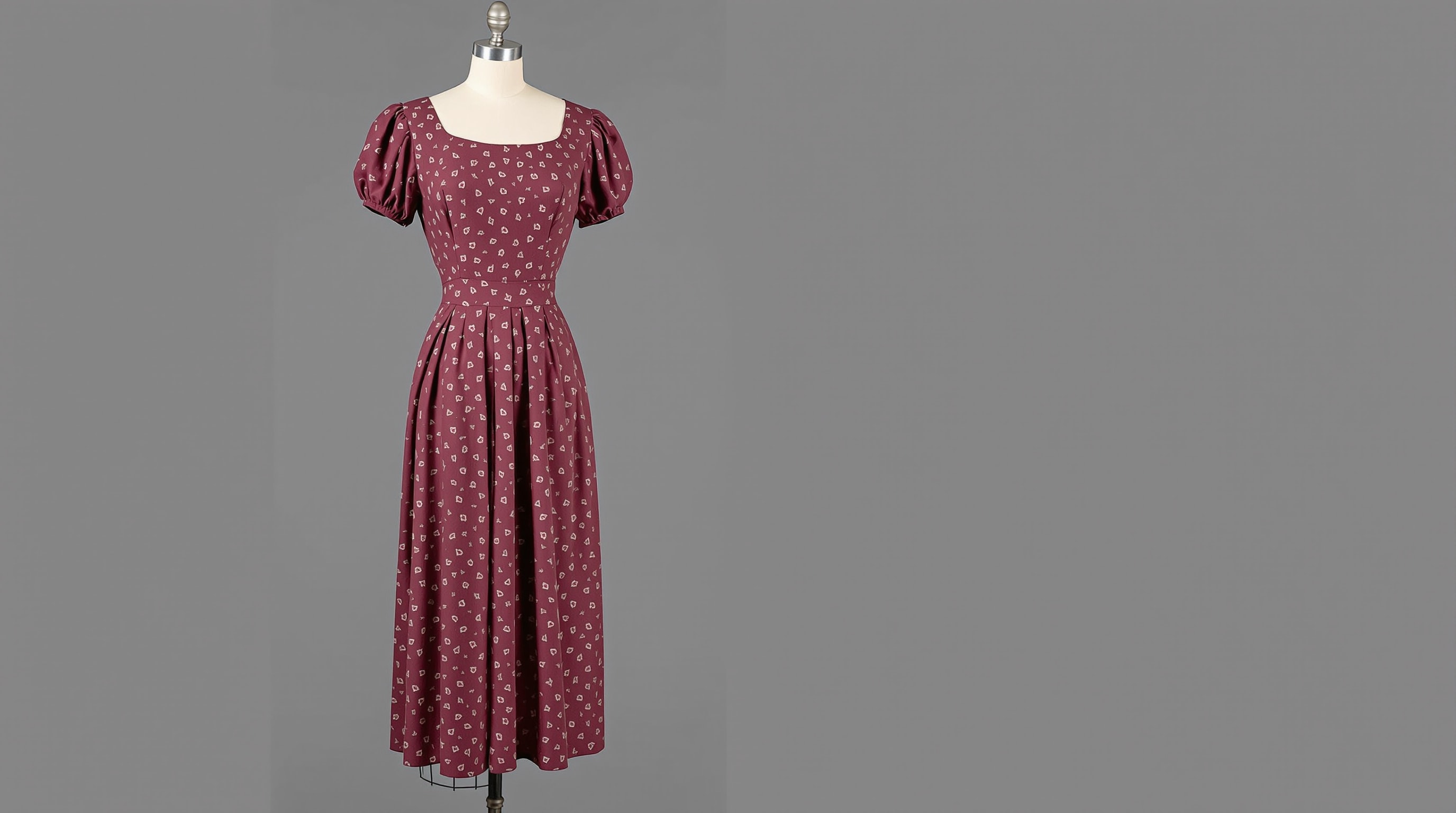
No other decade in the collection is shaped so directly by external constraint. Wartime rationing governed how much cloth a garment could contain, how deep a hem could be, how many buttons it could carry and how full a skirt could be cut — and the resulting silhouette is instantly recognisable because it was, in a literal sense, legislated.
The line
The shoulder squares up and broadens, frequently with a shoulder pad. The waist is defined and neat. The skirt is narrow — straight, or with a small number of pressed pleats or a modest A-line — and finishes at or just below the knee. The overall effect is upright, angular and slightly military, and it holds with remarkable consistency from about 1940 to 1947.
Then it ends abruptly. The 1947 New Look silhouette — tiny waist, enormous skirt, sloping shoulder, deliberate extravagance of cloth — reverses every wartime constraint at once and effectively begins the 1950s three years early. A garment showing a very full skirt and a rounded shoulder is post-1947 whatever else it looks like.
Substitution
Scarcity is written into the materials. Rayon becomes the default dress fabric in place of silk, which was diverted to war use; rayon crepe in particular is so characteristic that it is close to a decade marker on its own. Buttons, zips and metal fastenings were restricted, so garments make do with fewer of them and often use fabric ties, self-covered buttons or a simple side placket instead.
Improvisation goes further than substitution. Garments made from furnishing fabric, from blackout cloth, from unpicked older garments and — in documented cases — from parachute silk and nylon are a genuine part of the record rather than a curiosity. So are heavily mended and remade pieces; visible careful repair is period-correct, not a defect.
Prints and colour
Small-scale prints dominate: tiny florals, spots, geometrics and novelty prints on rayon, in a palette that runs to muted greens, browns, wine, navy and dusty blue. Large-scale bold print belongs to the following decade. Crepe, gabardine and lightweight wool carry the tailored end.
Bridal
Bridal shows the restriction plainly. Skirts are narrower, trains shorter or absent, and hems shallow. Long fitted sleeves and a high sweetheart or square neckline are typical, in rayon satin rather than silk. A great many brides married in a well-cut suit or in a good day dress, and a 1940s suit is a legitimate part of the bridal record rather than a compromise. Borrowed and remade gowns are common, so a 1940s dress showing alteration to fit more than one wearer is behaving exactly as expected. The bridal reference follows the sequence.
Condition
Rayon is the decade's weak point. It loses much of its strength when wet, so water-marking, shrinkage and seam distortion are common and frequently permanent, and any 1940s rayon garment should be kept well away from casual washing. Shoulder pads made from early foam will have crumbled or gone sticky. Metal zips of the period corrode and stain. Wool from this decade is prime moth material — see care and storage.
Dating notes
- Square, broad shoulder with a pad; narrow skirt at or just below the knee.
- Shallow hem, few buttons, minimal fastenings.
- Rayon dominant; polyester absent.
- Metal zip at the side seam, if there is one at all.
- Small-scale prints; visible period repair.
The V&A collections database holds substantial wartime dress material, and the Costume Society of America publishes scholarship on the period's manufacturing constraints.
Nothing described here is for sale, in stock, or available to order.