About Mill Crest Vintage
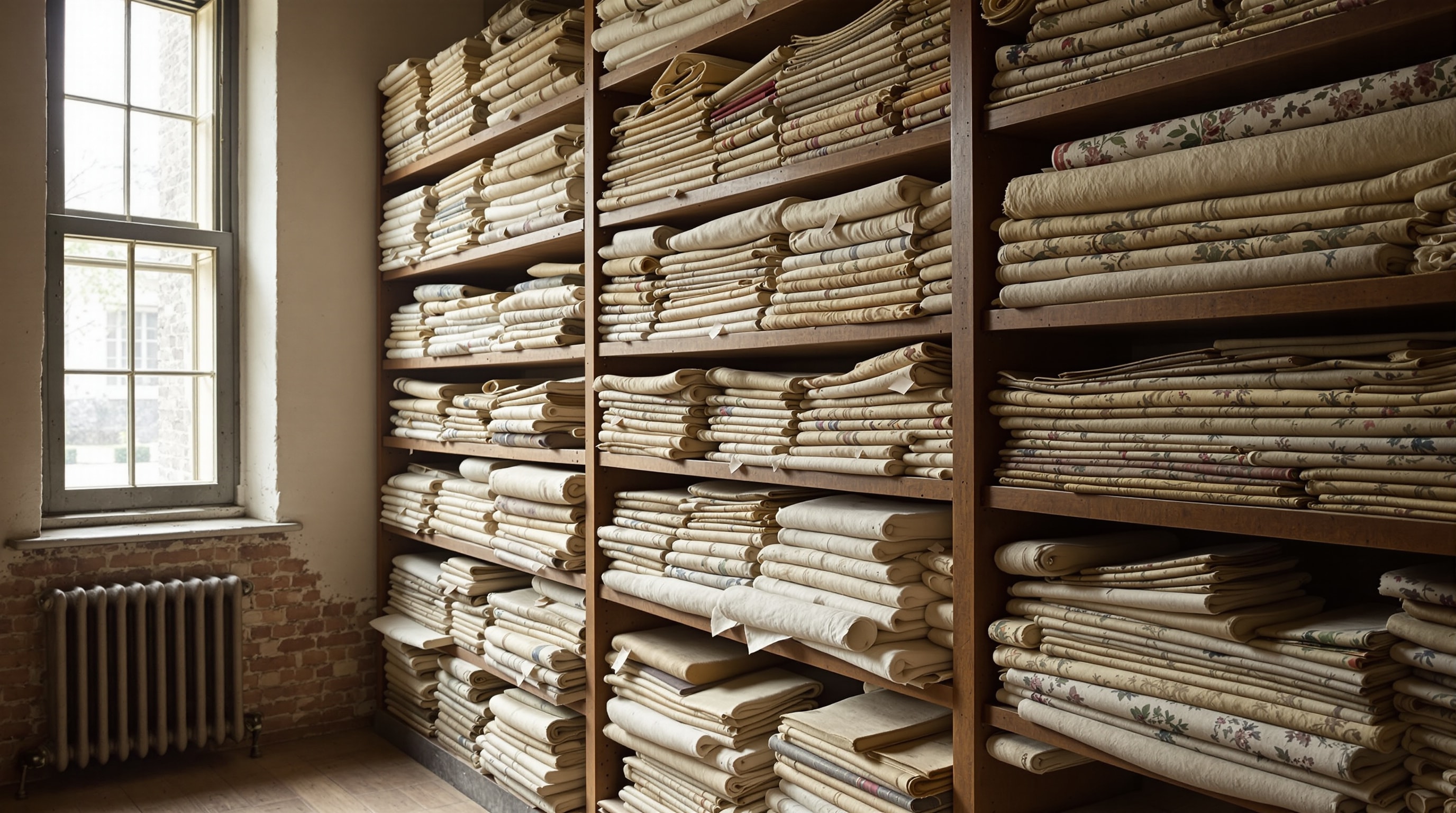
Mill Crest Vintage opened in 1985 in a seaside town just outside Boston, Massachusetts, trading in fine antiques and rare vintage textiles. It moved twice — first to the Berkshires, then to a small river town in western New Jersey — and over roughly thirty years assembled one of the larger privately held collections of antique cloth and vintage clothing in the north-east. The collection and its history are described here.
Textiles first
The collection did not begin with clothing. It began with cloth: lengths, fragments, sample books, trimmings and documents, gathered on buying trips during the off seasons and kept for reference rather than for resale. That order of priority shaped everything afterwards. The governing conviction was that the quality of a vintage piece can only be determined by its cut and its fabrication — not by its label, its decoration, or its decade — and that this is precisely what mainstream fashion stopped considering.
A textile library is a strange thing to build and an extremely useful one to have. It means that when a garment comes in, the question is not only what is this but what is it made of, and when was that made, and how was it finished. Those questions date a piece far more reliably than style does, because style is copied and revived constantly while manufacturing processes are not.
What the collection was for
The second conviction followed from the first: that while the fine details of a well-made vintage piece cannot be duplicated by mass manufacture, there is real value in its capacity to inspire. The collection was consulted by furniture, home and fashion designers, by film and theatrical costume departments, by stylists and by museum curators — people who needed to see how something had actually been done rather than read a description of it.
That is the value of studying the collection. This site is not a nostalgia project. It is a record of construction, materials and chronology, set down in the order the collection itself used.
Bridal
Vintage bridal entered the collection later and eventually came to dominate it. The reason is partly practical — wedding dresses survive better than any other category, because they were made from the best available cloth for a single wearing and then stored — and partly that the demand was there. The final years of the business were bridal almost exclusively, working on the principle that each dress taken in had to be as distinct as the person who would eventually wear it, which is a curatorial standard rather than a retail one.
The result is that the collection's deepest material is bridal and eveningwear, and its strongest single decade is the 1950s. That imbalance reflects the collection itself.
How to use this site
The vintage wedding dress reference and vintage evening dresses are the two long chronological pieces. Each era then has a page of its own, from the Victorian period through the 1990s. Underneath sit the material pages — textiles and care and storage — and two practical guides, on measuring and on wearing vintage.
For dated, provenanced comparison material, museum costume collections remain the best free reference available; the Kyoto Costume Institute and the Victoria and Albert Museum both publish detailed catalogue records.
Mill Crest Vintage is no longer trading. Nothing described here is for sale, in stock, or available to order; no appointments, valuations or appraisals are offered; and no affiliation is claimed with any manufacturer, designer, retailer or museum named on this site.