1970s Vintage
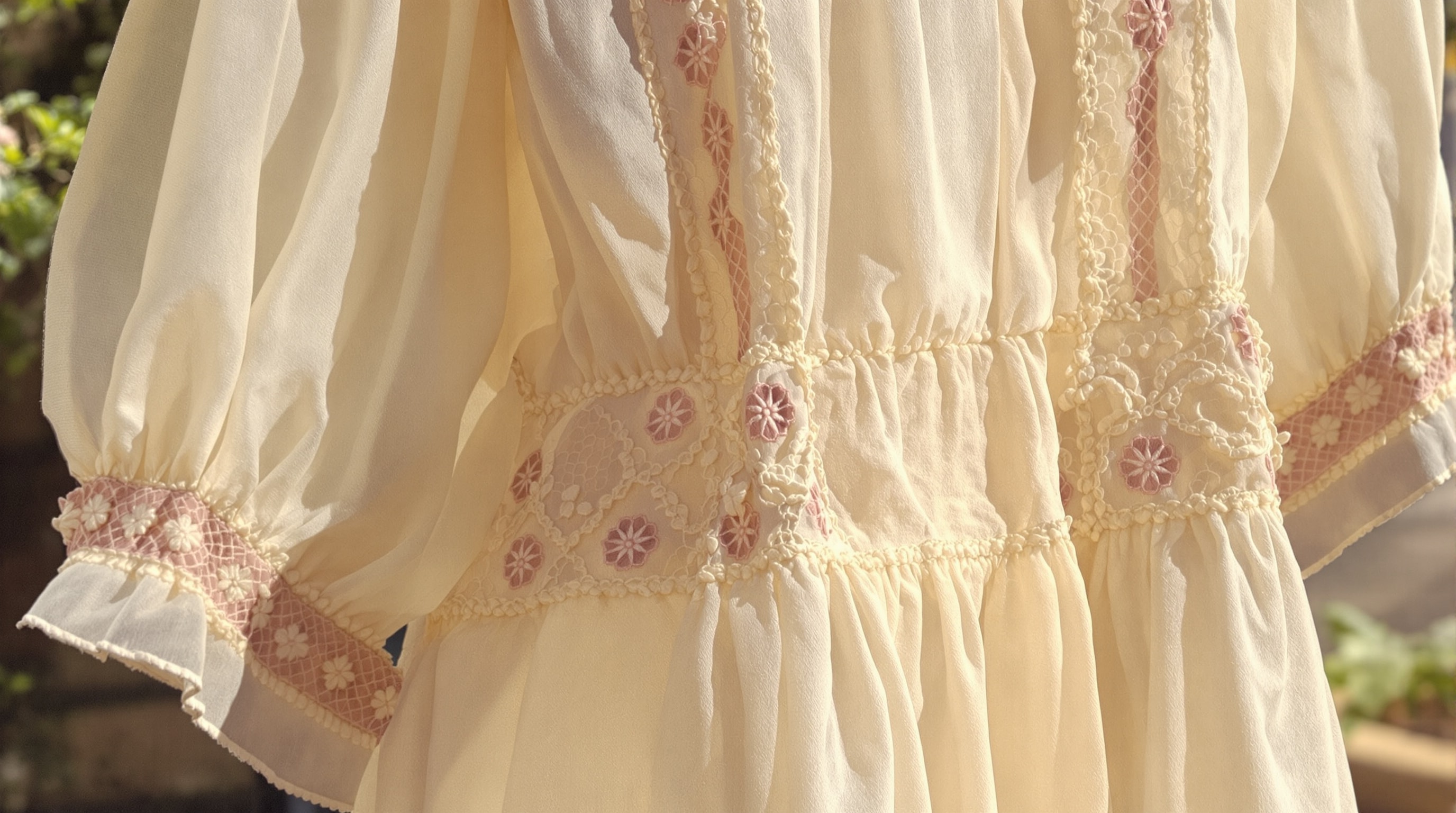
After a decade of hard fabric and flat shapes, the 1970s go soft. The waist returns to its natural place, cloth becomes fluid again, and the whole decade develops a distinctly backward-looking romanticism — borrowing from the Edwardian period, from folk dress and from the nineteenth century, and doing it with genuine affection.
The line
Two shapes carry the decade. The first is fitted at a natural or slightly raised waist with a long, full, gathered or tiered skirt — the romantic line. The second is the fluid column: a bias or jersey dress falling straight from the shoulder with no defined waist at all, cut for movement rather than for structure.
Sleeves are where the decade signs its name. Bishop sleeves gathered into a cuff, full bell sleeves, angel sleeves, juliet sleeves gathered at the shoulder — sleeve volume is the most reliable single 1970s marker, and it is the detail that most often gives away a modern reproduction, which never quite commits to the scale.
Fabric
Cotton voile, lawn, gauze and crinkle cotton at the light end; polyester jersey, crepe and qiana in quantity at the practical end; velvet, corduroy and challis in winter weights. Broderie anglaise, crochet, macramé and eyelet trim are everywhere and are an important part of the decade's texture.
Prints run to small ditsy florals, calico prints, folk and paisley motifs, and earth-toned geometrics — the palette is rust, ochre, olive, brown, cream and dusty rose. Polyester is dominant enough that its presence tells you little, but its absence in a garment claimed for this decade is worth noticing. See textiles.
Bridal
1970s bridal is one of the most distinctive looks in the collection: high necked, long sleeved, natural waisted, with a full gathered skirt in cotton voile or polyester chiffon, heavily trimmed with lace insertion, ruffles and broderie anglaise. Empire lines persist from the previous decade early on. Headdresses are floral wreaths and wide-brimmed hats rather than structured pieces.
It is also the decade in which vintage bridal becomes self-aware — 1970s gowns are frequently deliberate evocations of Edwardian and Victorian dress, which means an inexperienced eye can date a 1970s garment eighty years too early. The tells are the fabric (polyester or modern cotton rather than fine lawn), the closure (a long nylon coil zip rather than hooks or buttons), the machine lace and the overlocked seams. The bridal reference covers the sequence.
Condition
The decade generally survives well. Polyester is close to indestructible, and the cottons wash. The specific problems are yellowing of white polyester and nylon lace, perished elastic in shirred and smocked panels, and delamination in any bonded fabric. Colours from the period fade less than earlier natural dyes but the earth tones dull noticeably in light. See care and storage.
Dating notes
- Natural waist restored; substantial sleeve volume.
- Long nylon coil zip; machine overlocked seam finishes.
- Broderie anglaise, crochet and eyelet trim.
- Earth-toned palette, ditsy and folk prints.
- A historicising style executed in unmistakably modern materials.
The Kyoto Costume Institute holds dated 1970s material useful for separating genuine period pieces from their historical models.
Nothing described here is for sale, in stock, or available to order.