Vintage Evening Dresses
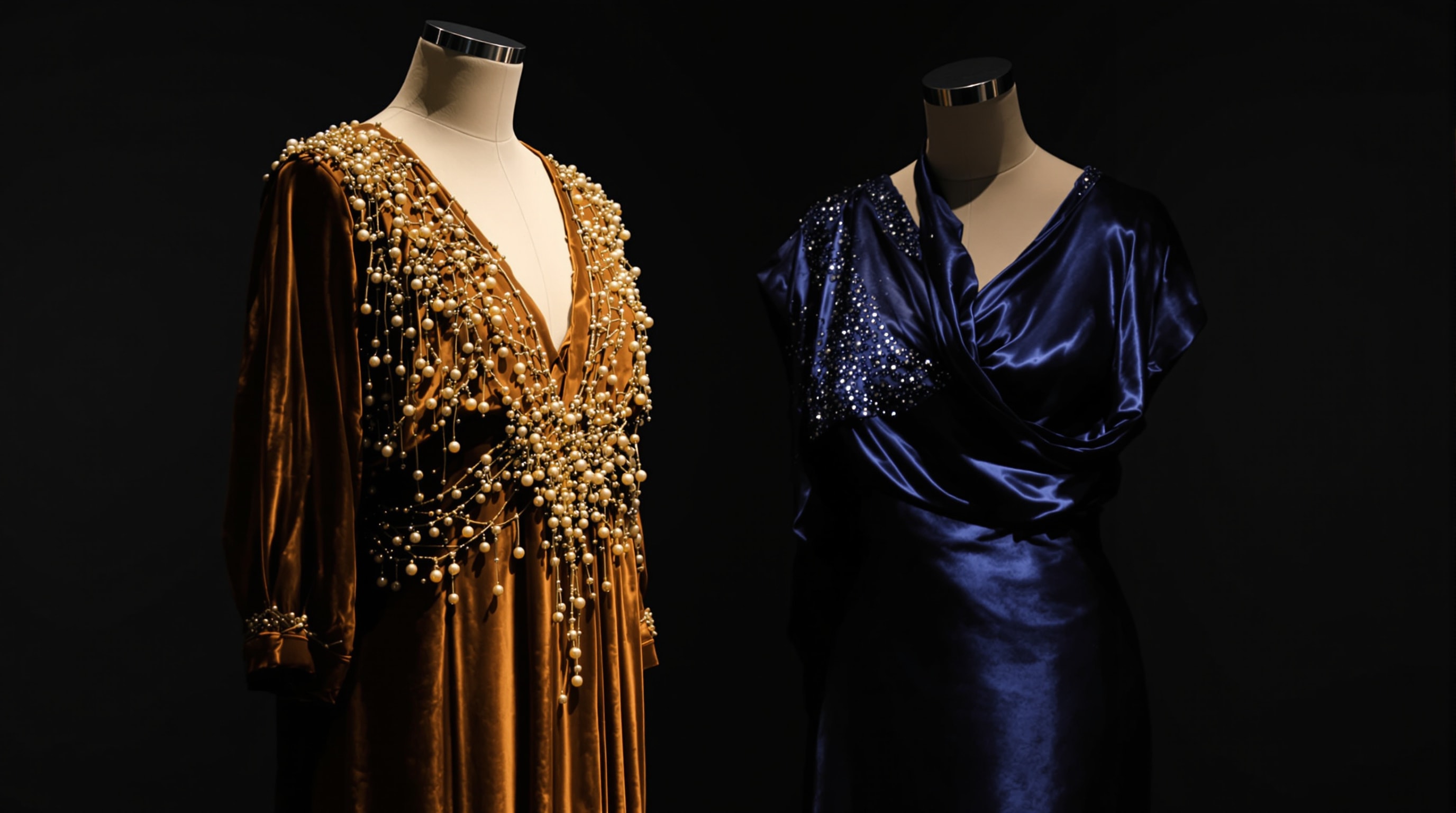
Eveningwear is the most consistently well-made category in the collection and the least written about. A dress made for evening was made from better cloth, with more interior structure and more hand-finishing, than a day dress of the same date and the same household — and because it was worn rarely, a great deal of it survives. For anyone learning to read period construction, evening dress is the best teacher available.
Evening, dinner, cocktail: three different garments
The distinctions were real and they show in the cut. Full evening dress meant floor length, bare or minimally covered shoulders, and the richest available fabric. Dinner dress covered more — a higher neck, some sleeve — and was cut for a seated, longer occasion. The cocktail dress is the newcomer: it emerges properly between the wars as a short, formal, early-evening garment, and it becomes a fixed category in the 1950s. A short formal dress in a rich fabric with elaborate finishing is almost never pre-1930s, and dating one earlier is a common error.
How the line moves
The Edwardian evening gown is built over a full foundation, with a low square or rounded neckline, elaborate applied trimming, and a train. Boning is stitched into a separate interior bodice lining, and the outer fabric is often quite loosely attached to it — a construction that regularly confuses people encountering it for the first time.
The 1920s strip the foundation out. Evening dress becomes a straight beaded or sequinned tube, frequently in two layers, with the surface decoration carrying all the visual weight. This is the decade in which the most spectacular and the most fragile evening dresses were made, and the two facts are related.
The 1930s are the high point. Bias-cut satin and crepe, backless to the waist, cut with a precision that is genuinely difficult to reproduce. Weight, drape and the long unbroken line do the work; decoration is minimal and often confined to a shoulder or a hip detail. A 1930s evening gown handled flat looks unremarkable — it only makes sense on a body.
The 1940s square the shoulder and shorten the line under rationing, and rayon crepe becomes the default evening fabric in place of silk. The 1950s restore the structure entirely: strapless boned bodices, enormous skirts over layered net, silk taffeta and faille, and the fully realised cocktail dress in its own right. The 1960s flatten it again into a sculptural column or a raised-waist shift, in heavier fabrics that hold their own shape. The 1970s soften into fluid jersey and chiffon, and the 1980s return to structure at its largest scale before the 1990s reduce it to the matte column.
What to look for in the construction
- Interior foundation. Evening bodices frequently contain a complete second garment — a boned, waist-stayed inner bodice that carries the fit while the outer layer floats. Its presence and its construction date the piece more reliably than the outside does.
- Waist stays. A grosgrain tape with a hook at the waist, inside the bodice, takes the weight of a heavy skirt off the shoulders. Common from the Edwardian period through the 1950s.
- Weighting. Small chain or coin weights in a hem, used to make a bias or chiffon skirt hang correctly. Characteristic of good 1930s work.
- Hand-finishing. Hand-rolled hems on chiffon, hand-applied beading on a net ground, and hand-worked thread loops all indicate quality and generally earlier date.
- Decoration technique. Beading worked directly onto the garment differs from beading worked on a separate applied panel; the latter is more often later and more often commercial.
The fragility problem
Evening dress concentrates exactly the failure modes described under condition. Heavy beadwork on light ground fabric is the signature evening-dress problem, and weighted silk — much used for evening taffeta — is the signature evening-dress loss. Metallic lamé of the 1920s and 1930s presents a third: the metal-wrapped threads oxidise and become brittle and abrasive, cutting the fibres around them. None of these are reversible.
Dark colours bring their own difficulty. Black and deep dyes of the period are often unstable and will crock — transfer onto skin or onto a lighter fabric — and early aniline dyes fade unevenly and unpredictably in light.
Further reference
The Kyoto Costume Institute and The Museum at FIT both hold deep eveningwear collections with published catalogue records, and are the most efficient way to compare a piece against firmly dated examples. Storage recommendations for beaded and weighted garments are set out under care and storage, and the fabrics themselves are covered under textiles.
Nothing described here is for sale, in stock, or available to order.