1980s Vintage
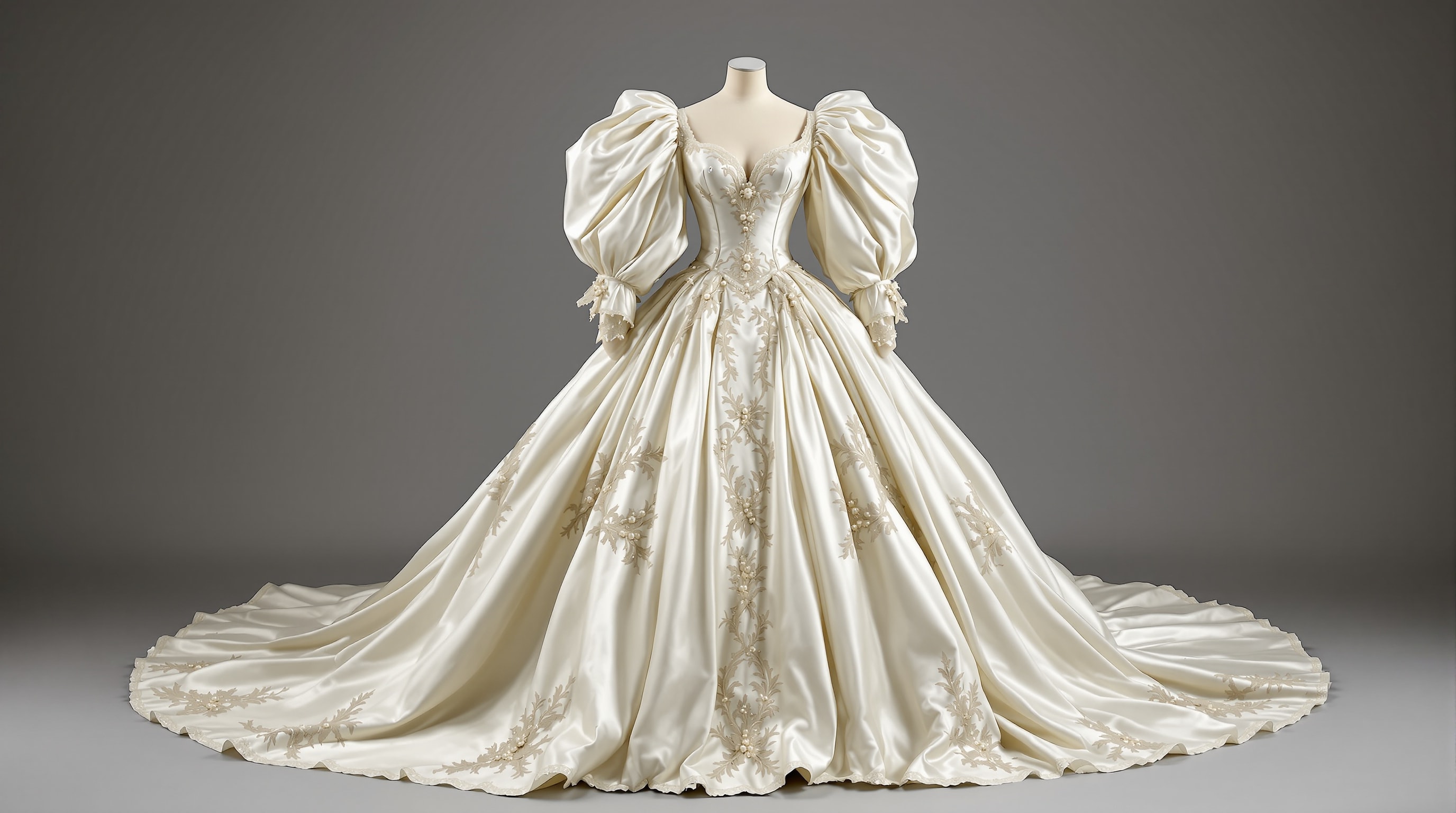
The 1980s reverse the 1970s completely and do it at volume. Everything gets bigger — shoulders, sleeves, skirts, trims, decoration — and it is all held up by interior structure of a kind not seen since the 1950s. It is the last decade in the collection in which garments are built rather than merely sewn.
The line
The shoulder is the organising feature. Pads are large, frequently doubled, and set to give a hard horizontal line well beyond the natural shoulder point. Everything else is arranged in relation to it: a narrow waist emphasised by contrast, and then either a very full skirt or a narrow one, in a deliberate inverted triangle.
Sleeves are large and often architectural — the leg-of-mutton sleeve returns properly, gathered into an enormous puff at the shoulder before narrowing to the wrist. Peplums, ruffles at the shoulder and hip, and applied bows at scale are all characteristic.
Fabric and surface
Taffeta, moiré, heavy satin, velvet and lace over structured underlayers. Decoration is applied lavishly and is frequently machine-made and sizeable: large sequin and bead panels, appliquéd lace motifs, pearl trim, ruffle layers. The palette is high-contrast and saturated — jewel tones, strong brights, and a great deal of black and white.
Synthetics dominate almost completely, which makes fibre less useful for dating within the decade than construction is. See textiles.
Bridal
1980s bridal is the most maximal in the collection. The characteristic gown has an enormous puffed or leg-of-mutton sleeve, a fitted boned bodice, a very full skirt over stiff net, a long train, and heavy applied lace, pearl and sequin decoration — often all at once. The scale is deliberate and the garments are genuinely heavy; a full 1980s gown with its underskirts can be difficult to lift.
Because the decade borrows historical elements — Victorian sleeves, a nineteenth-century bustle effect at the back — the same misdating risk applies as in the 1970s, but the fabrics settle it immediately. The bridal reference places it in sequence.
Condition
Structurally these garments hold up well. The failures are in the components rather than the cloth: foam shoulder pads crumble or go sticky and yellow, and frequently stain the fabric around them; applied sequins and beads on machine-stitched chains unravel from a single broken thread, so a small break becomes a long bare run; and bonded interfacing delaminates and bubbles, which is not repairable.
Perspiration damage is common because the synthetics do not breathe. Stiff nylon net underskirts yellow and become brittle. See care and storage.
Dating notes
- Large shoulder pads set beyond the natural shoulder line.
- Leg-of-mutton or heavily puffed sleeves; peplums and large applied bows.
- Machine-applied sequin and pearl decoration at scale.
- Synthetic fabrics throughout; bonded interfacings.
- Considerable weight for the size of the garment.
The Museum at FIT holds well-documented late twentieth-century dress.
Nothing described here is for sale, in stock, or available to order.