Vintage Wedding Dresses: A Decade-by-Decade Reference
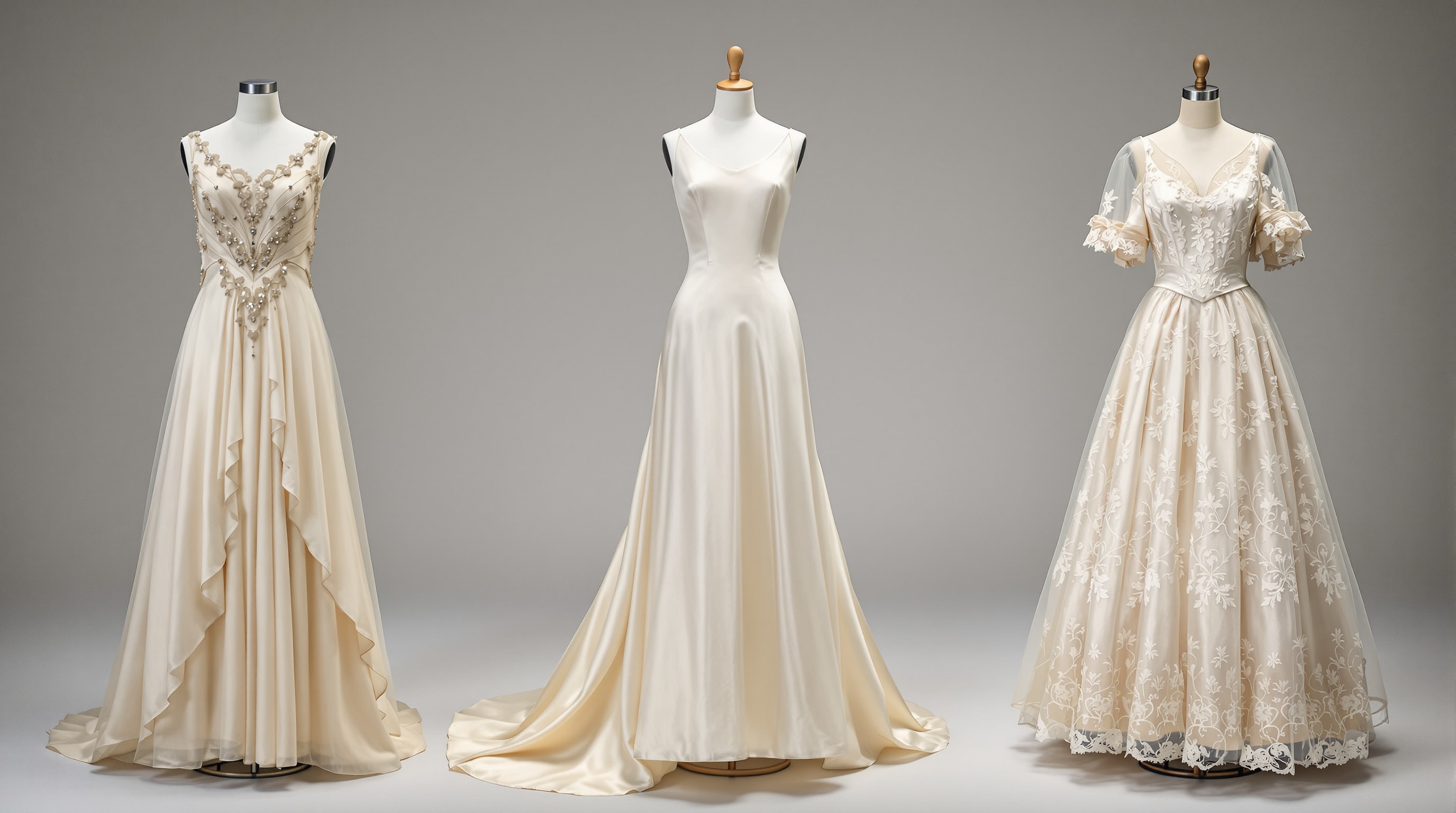
A wedding dress is one of the most reliably datable garments in any collection. It was usually made for a fixed occasion, from the best cloth the household could manage, in the silhouette of its exact moment — and then it was worn once and put away. That combination is why bridal survives in better condition than almost any other category of clothing, and why it maps the century so precisely.
This page traces the line across the whole period the collection covers. Each decade has a fuller page of its own; what follows is the through-line that connects them, and the practical business of telling one from another.
Before white was the rule
The white wedding dress is younger than most people assume, and for most of the nineteenth century it was a minority choice. A bride generally married in her best dress, which was frequently coloured — brown, grey, deep blue, wine — because a good dress was expected to go on being worn afterwards. Surviving Victorian bridal is therefore often indistinguishable from formal day dress of the same date, and is dated by its construction rather than its colour: hand-worked buttonholes, piped seams, cartridge-pleated skirts set into a narrow waistband, and interior boning stitched to a separate lining.
White gained ground through the second half of the century as a display of means — a dress that could not be worn again and could not survive laundering was a statement about being able to afford it. By the Edwardian period it was established for those who could manage it, and the characteristic gown is pale, high-necked, long-sleeved and built from remarkably fine cotton lawn, net and lace, with the pouched front and long back of the S-bend line.
The 1920s: the waist drops and the structure goes
The 1920s produced the first bridal silhouette that a modern eye reads as genuinely unstructured. The waist falls to the hip or vanishes entirely, the bodice hangs rather than fits, and the whole garment is often suspended from the shoulders. Hems rise through the decade and are frequently uneven — longer at the back, or handkerchief-pointed. Beadwork and metallic thread are common, and are also the most common site of damage: heavy glass beading on lightweight silk chiffon tears its own ground fabric over time, and a 1920s dress that has been stored on a hanger has usually suffered for it.
The 1930s: cut replaces construction
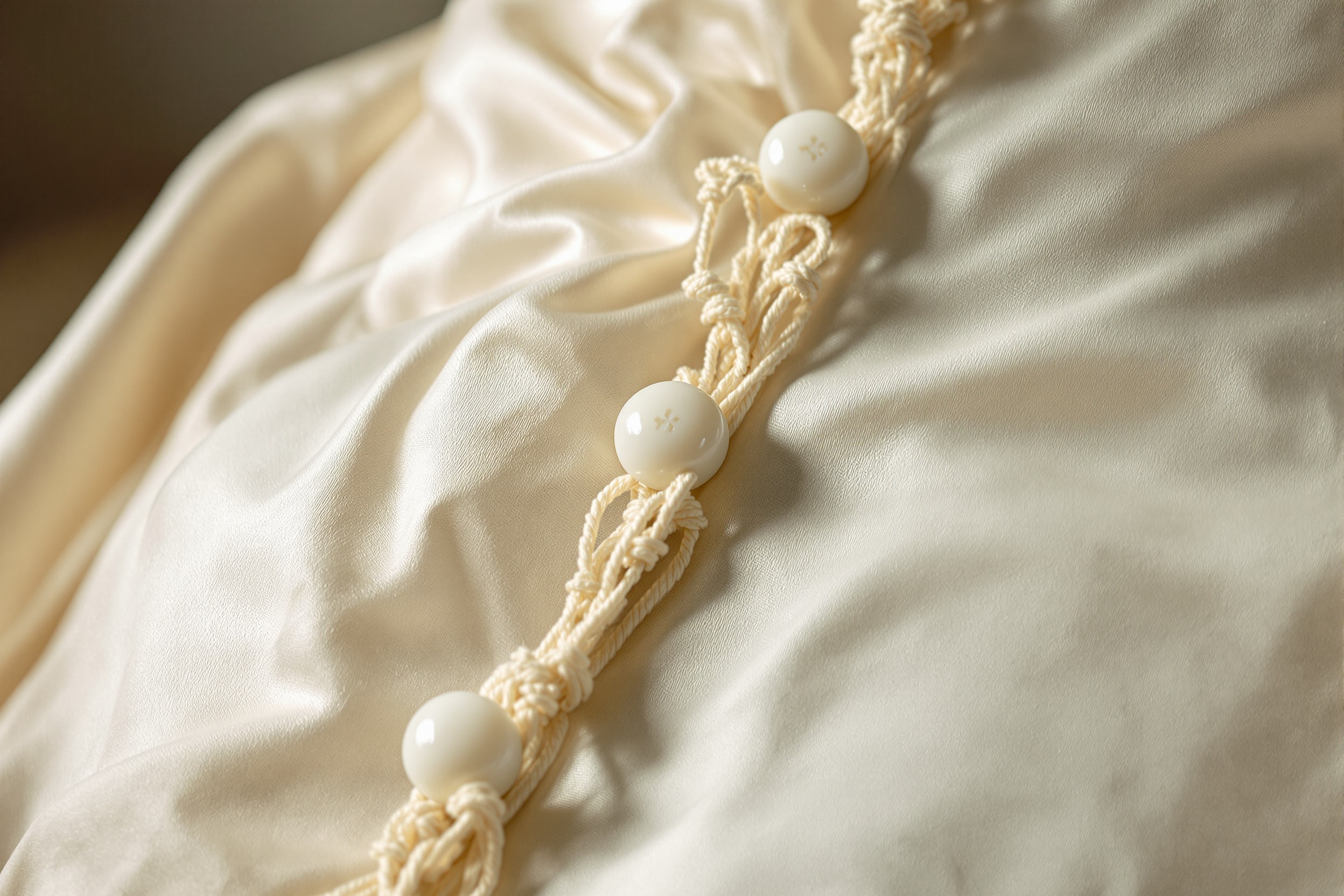
The 1930s are, technically, the most accomplished decade in the period. The waist returns to its natural place and the body reappears, but it is achieved through cutting rather than boning — cloth taken on the bias so that it stretches diagonally and moulds to the figure without a single dart. A true bias gown is unmistakable once you have handled one: it is heavy for its size, it falls in a long unbroken line, and the side seams spiral very slightly. Panelled skirts, cowl necks, and long trained backs belong here, usually in silk satin or crepe.
The 1940s: restriction and substitution
Wartime rationing shows plainly in 1940s bridalwear. Fabric restrictions produced narrower skirts, shorter trains and shallower hems; the silhouette squares up at the shoulder and nips at the waist. Two features date this decade almost on their own: the widespread use of rayon in place of silk, and the frequency with which gowns were made from whatever was available — including, in documented cases, parachute silk and nylon. Many 1940s brides simply married in a good suit, and a well-cut suit of this date is a legitimate part of the bridal record.
The 1950s: the full skirt and the tea length
The 1950s are the deepest part of this collection and the decade most people picture. The 1947 New Look silhouette — a tightly fitted bodice over an enormously full skirt, supported by layered net petticoats and often by an integral boned foundation — defines the formal end. At the informal end sits the tea-length dress, finishing between the knee and the ankle, which was the ordinary choice for a great many weddings and which survives in quantity. Lace over tulle, embroidered organdy, silk taffeta with a distinct rustle, and the strapless bodice with a detachable jacket are all firmly of this decade.
The 1960s: the waist rises and the hem lifts
The 1960s raise the waist towards the bust and simplify everything below it. The empire line and the A-line dominate, sleeves narrow, and surface interest moves to the neckline and headdress. Hems climb through the decade; by its end, short bridal is entirely ordinary. Heavier, more sculptural fabrics — faille, ottoman, peau de soie — support the flatter shapes, and machine-made lace of consistent repeat becomes the norm.
The 1970s and after
The 1970s return to the natural waist with a soft, historicising line: high necks, long full sleeves, gathered skirts, and a great deal of cotton voile, crochet and broderie anglaise. The 1980s reverse it entirely, scaling up shoulder, sleeve and skirt over heavy interior structure. The 1990s then strip the whole thing back to a matte, narrow, largely undecorated column. Each of those is covered in full on its own page.
Dating a gown when the label is gone
Most surviving gowns carry no useful label, and the ones that do are frequently retailer rather than maker. The construction is more honest than the label in any case. In rough order of reliability:
- Closures. Hooks and hand-worked bars, or a long side placket, point to pre-war. Metal zips appear in dresses from the 1930s onward and are common by the 1940s; nylon coil zips indicate the 1960s at the earliest.
- Seam finishes. Hand-overcast or pinked raw edges are earlier; machine overlocking on a bridal seam is late in the period.
- Interior structure. A separate boned foundation stitched into the bodice is characteristic of the 1950s. A bodice with no internal support at all suggests the 1920s or the 1960s.
- Where the waist sits. The single fastest indicator, and reliable across the whole period.
- Fibre. Rayon narrows the range to the 1930s or later; polyester to the 1960s or later. See textiles for how to tell them apart by hand and by burn test.
Further reference
For comparison against dated, provenanced examples, museum collection databases are the most useful free resource available. The Victoria and Albert Museum and the the Kyoto Costume Institute both publish catalogue records with construction detail and firm dates, and the Costume Society of America maintains scholarship on North American dress specifically.
If you are looking at a specific gown with a view to wearing it, the companion page on assessing a vintage wedding dress covers condition and alteration, and measuring for a vintage dress covers fit.
No garment described here is for sale, in stock, or available to order.