Victorian
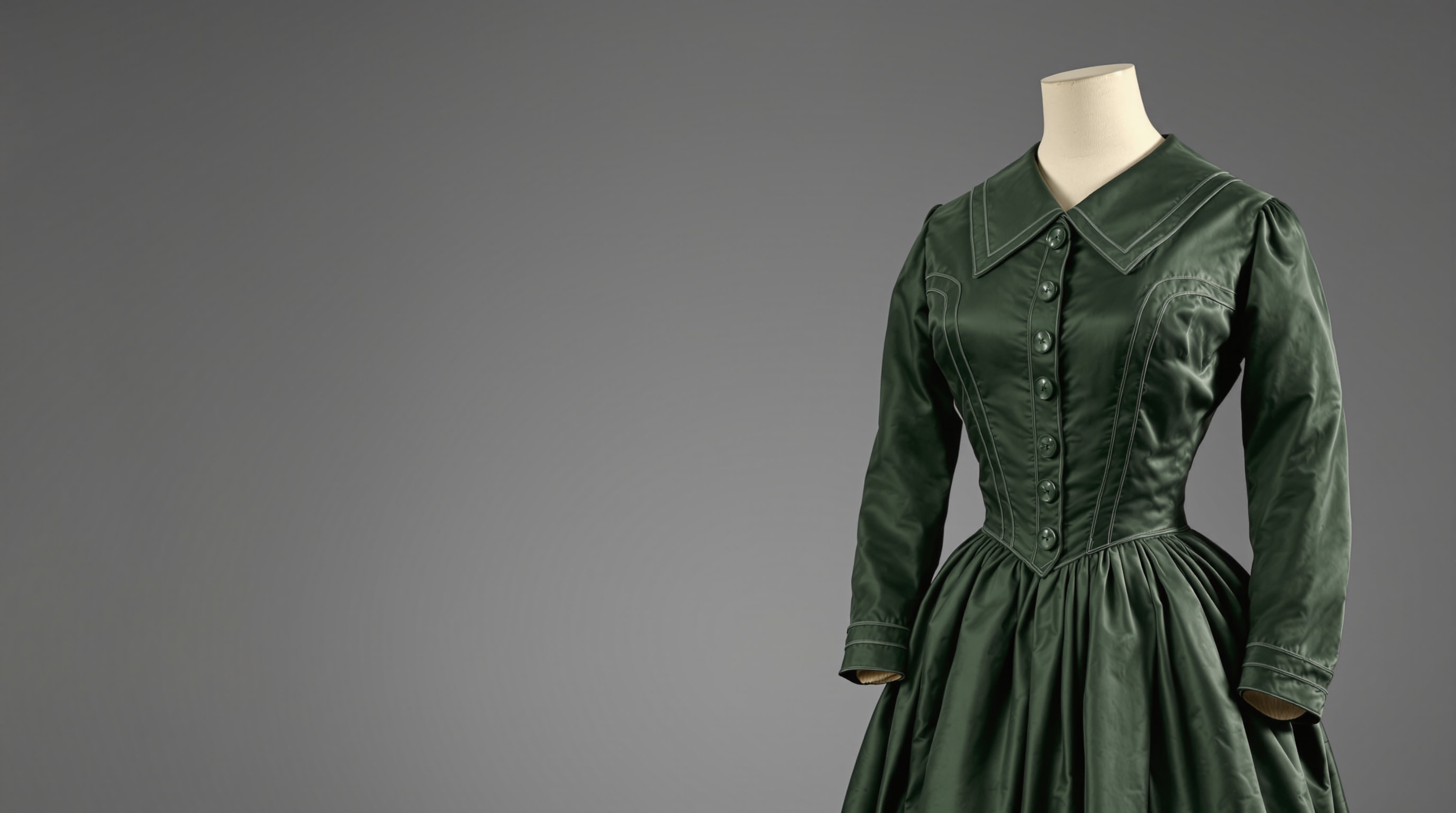
The Victorian period runs longer than any other era in this collection and changes more within itself. A dress from 1845 and a dress from 1895 have almost nothing in common beyond the fact that both are boned. What makes the period coherent is not silhouette but method: this is the last era in which almost everything was made for one person, and the construction shows it on every seam.
The silhouette in three movements
The fullness moves, and where it sits dates the garment. Through the 1840s and 1850s it is distributed evenly all round, supported first by layered petticoats and then, from the mid-1850s, by the cage crinoline — a hooped understructure that made an enormous skirt possible without unbearable weight. Through the 1860s the fullness migrates to the back. By the 1870s and again in the 1880s it concentrates there entirely in the bustle, which projects sharply from a flat front. The 1890s abandon it: the skirt becomes a smooth gored bell and the volume transfers upward into a very large sleeve.
How a Victorian bodice is built
The bodice is the technically interesting part and the most reliable place to look. It is generally constructed as a fitted lining and an outer fabric worked together, with narrow whalebone or steel boning stitched into casings along the seams. It fastens with hooks and hand-worked bars, or with small covered buttons and thread loops. A waist tape inside carries the weight. Seams are frequently piped, and raw edges are hand-overcast or left pinked.
Because the bodice was fitted to one body, it is often startlingly small through the ribcage and shows adjustment marks from repeated alteration — Victorian garments were remade as a matter of course, and a bodice that has been let out, taken in, re-sleeved and re-trimmed across two decades is completely normal.
What the machine changed
The sewing machine enters domestic and commercial use through the 1850s and 1860s, and its arrival is one of the best dating tools in the period. Early machine stitching appears on long straight structural seams while everything requiring judgement — buttonholes, hems, trimming, finishing — stays hand-worked. A garment that is entirely hand-sewn is likely to be early; one with machine seams and hand finishing is mid-period; wholly machine-finished work is late or later.
Colour and dye
The synthetic dye industry begins in 1856 and transforms the palette within a decade. The intense purples, magentas, acid greens and strong blues that people find surprising in surviving Victorian dress are genuine, not faded misreadings — they were new, fashionable and expensive. These early aniline dyes are also unstable: they fade unevenly under light, and a gown that now reads as two different browns may have started as a single vivid colour.
Bridal
White was a minority choice for most of the period. A bride generally married in her best dress, in whatever colour it happened to be, because it was expected to go on being worn. Surviving Victorian bridal is therefore frequently indistinguishable from formal day dress of the same date, and is identified by provenance rather than by appearance. See the decade-by-decade bridal reference for how this shifts.
Condition
Victorian silk is the era's characteristic loss. Weighting was in wide use, and weighted silk taffeta from this period shatters along the grain into fine vertical splits that cannot be repaired. Cotton and wool of the same date frequently survive in far better order. Metal boning rusts and stains the fabric around it, and early rubber elastic in later pieces has invariably perished. The textiles page covers identification, and care and storage covers what to do with what survives.
For dated comparison, the Victoria and Albert Museum and the Costume Society both publish nineteenth-century dress records with construction notes.
Nothing described here is for sale, in stock, or available to order.