Caring for and Storing Vintage Textiles
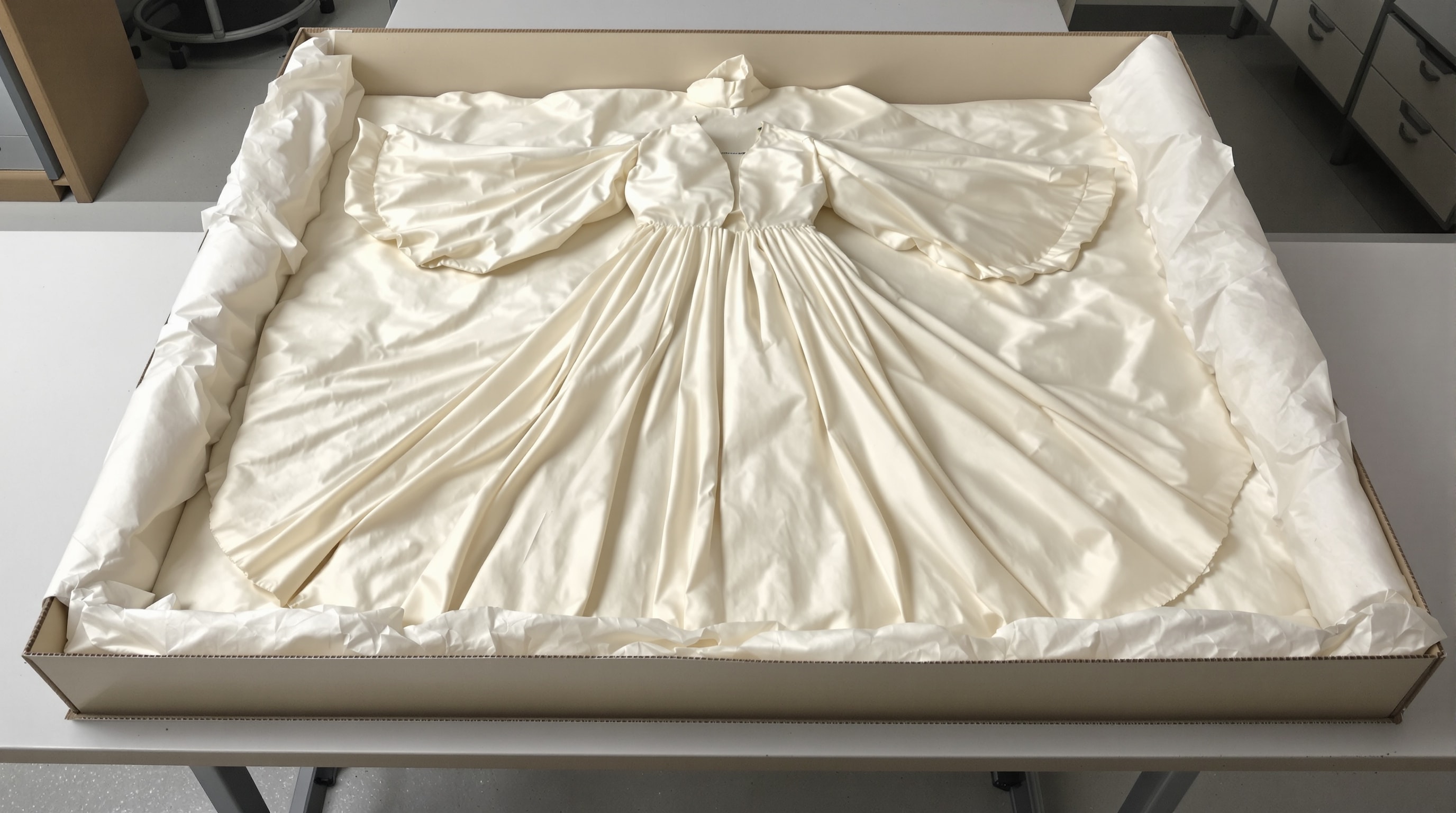
Most damage to vintage clothing happens in storage, not in wear. A garment that has survived eighty years can be ruined in five by a plastic cover, a wire hanger and an attic. The recommendations below follow standard museum textile practice, which is unusually well documented and freely published, and almost all of it is cheap to apply.
Hang or lay flat?
The default answer is flat. Gravity is the constant load on a stored garment, and it works on the weakest point available — the shoulders. Anything heavy, anything beaded, anything cut on the bias and anything with a compromised shoulder seam should be stored flat, interleaved with acid-free tissue and supported so that no fold bears the weight of the garment above it.
Where a garment must hang — long, light, sound and unbeaded pieces only — the hanger must be padded so that it matches the shoulder width exactly. A narrow or wire hanger concentrates the entire weight of the dress on two small points and will eventually tear through. Never hang a 1920s beaded dress under any circumstances; the beadwork will saw through its own ground fabric.
Unpacking a stored garment
Prepare a clear, clean surface before opening the box. Move loose tissue aside a layer at a time and find the folds before lifting anything. A sleeve, train or waistband may be tucked beneath the main body; pulling the visible part can put the whole weight through that hidden connection. Bring the supporting tissue with the garment, keeping the underside supported rather than lifting from the neckline or fastening.
For a brief inspection, unfold only what is needed and keep detached trim or loose components beside the piece. Note where they belong without pinning them back onto fragile cloth. Before repacking, check that sleeves and decorated edges are resting on padding, that fastenings are not caught in lace, and that the lid closes without pressing the contents down. Leave room for the padding as well as the dress.
Materials that touch the garment
- Acid-free, unbuffered tissue for interleaving and for padding out folds and sleeves. Unbuffered matters for silk and wool, which are protein fibres and prefer a neutral to slightly acidic environment; buffered (alkaline) tissue is intended for cellulose materials.
- Washed, unbleached cotton sheeting or muslin as a dust cover. It breathes.
- Acid-free boxes rather than ordinary cardboard, which is acidic and will discolour and embrittle what it touches.
Avoid, without exception: plastic garment bags and plastic boxes, which trap moisture and off-gas; cedar chests and unsealed wood, which are acidic and release volatile compounds; ordinary tissue and cardboard; rubber bands and adhesive tape; and mothballs, which are toxic, leave a permanent smell, and can react with some plastics and finishes.
Light, temperature and humidity
Light causes cumulative, irreversible fading and fibre breakdown, and ultraviolet is the worst part of it but not the only part. Store in the dark. If a garment is displayed, accept that it is being spent, and keep the exposure low and the duration short.
Aim for cool, stable and moderately dry. Fluctuation is more damaging than any particular value, because fibres take up and release moisture and swell and contract as they do. This is the reason attics and basements are the two worst places in a house: attics swing violently in temperature, basements in humidity. An interior cupboard on a living floor is usually the best available compromise.
Pests
Clothes moths and carpet beetles eat protein fibres — wool, silk, feathers, fur — and are drawn to soiling on them. They do not eat cotton or synthetics, though they will damage them incidentally. The practical defence is inspection rather than chemistry: check stored items at least twice a year, look for grazed surfaces, tiny larval cases and shed skins as much as for adult insects, and isolate anything new for a period before it joins the rest. Freezing is the standard non-chemical treatment for an infested item, and requires a genuinely low temperature held for a sustained period.
Cleaning before storage
Soiling attracts pests and causes staining that becomes permanent with age — sugars in particular oxidise into brown marks that are effectively unremovable once set. So a garment should ideally be clean going into storage. But cleaning a period garment is itself a risk, and the wrong process is worse than the soiling: solvents dissolve early plastics, gelatin sequins and some adhesives; water swells and weakens rayon and can bleed unstable dyes; and weighted silk should not be wet-cleaned at all.
If something must be cleaned, identify the fibre first — see textiles — and consider whether the piece warrants a conservator. The American Institute for Conservation maintains a public directory for finding one.
Published guidance
Three free sources are worth more than any summary of them. The Library of Congress publishes concise care guidance for textiles; the National Park Service Conserve O Gram series covers storage, mounting and pest management in short practical leaflets; and the American Institute for Conservation publishes guidance on caring for treasured belongings and on when a piece warrants professional treatment.
This page offers general information only. Nothing described here is for sale, and no conservation, cleaning or appraisal service is offered.