1960s Vintage
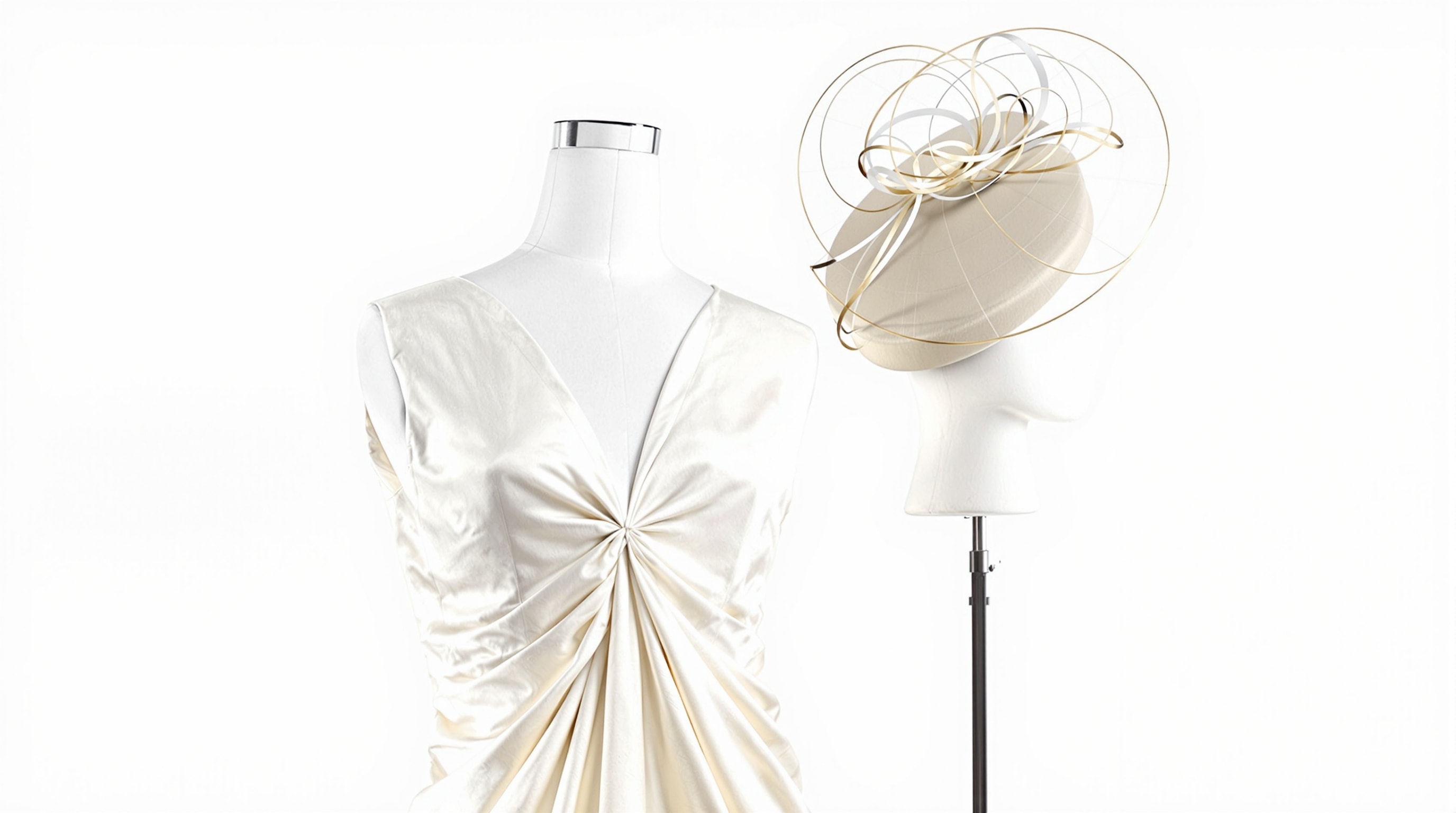
The 1960s move faster than any other decade in the collection. A dress from 1961 belongs recognisably to the 1950s; a dress from 1969 belongs to the 1970s. Dating within the decade therefore matters more than usual, and fortunately the markers are clear — the waist rises, the hem climbs, and the fabric gets stiffer before it gets softer again.
The line
The fitted natural waist gives way in two directions. The empire line raises the waist seam to just under the bust and lets everything below it fall straight or slightly flared. The A-line and shift abandon the waist seam altogether, hanging from the shoulders in a clean triangle or a straight column. Both flatten the body deliberately after a decade of emphasising it.
Hems climb steadily. Just below the knee at the start, at the knee by the middle, and unambiguously above it by 1966–67. Very short hems belong to the last third of the decade only.
Fabric does the shaping
With the interior structure gone, the fabric has to hold the shape itself, and the decade's materials reflect that. Faille, ottoman, gazar, heavy double-knit and crisp cotton piqué are all firm, sculptural cloths that stand away from the body. This is a genuine reversal: the 1950s used soft fabric over hard structure, the 1960s use hard fabric over none.
It is also the decade in which polyester arrives in quantity, which makes it a hard dating boundary — polyester means the 1960s at the earliest. Machine lace becomes entirely standard, with a mechanically exact repeat that distinguishes it immediately from earlier work. See textiles.
Colour and pattern
Early in the decade the palette is still soft — pastels, ivory, powder blue. It shifts hard through the middle years into saturated, high-contrast and often optical pattern: bold geometrics, op-art black and white, large flat colour blocks. By the end, the psychedelic and folk-influenced prints that carry into the 1970s are established.
Bridal
Bridal follows the same simplification. The empire-line gown with a small bodice and a straight fall is the decade's signature, frequently with a detachable watteau train from the shoulders. Sleeves narrow into a slim fitted line or vanish. Necklines rise to a plain jewel or bateau. Surface interest concentrates almost entirely at the neckline and, above all, in the headdress — the pillbox, the bow and the elaborate structured headpiece with a short veil are the decade's real bridal statement.
Short bridal becomes entirely ordinary by the end of the decade. The bridal reference places it in sequence.
Condition
The 1960s introduce failure modes not found in earlier garments in the collection. Early polyester and acetate can be heat-damaged irreversibly and will melt under an iron. Bonded and fused fabrics — two layers glued rather than stitched — delaminate with age and cannot be repaired. Elastic and foam from this decade have almost invariably perished. Nylon coil zips become standard and are a useful dating marker in themselves. Set against that, the synthetics do not attract moths and do not fade as readily as earlier natural dyes, so a 1960s garment often survives structurally sound even when it has aged badly in other ways. See care and storage.
Dating notes
- Waist raised to under the bust, or no waist seam at all.
- Hem position — the single fastest way to place a garment within the decade.
- Stiff, sculptural fabric holding its own shape.
- Polyester or bonded fabric present; nylon coil zip.
- Machine lace with an exact repeat.
The Victoria and Albert Museum and The Museum at FIT hold well-dated 1960s material.
Nothing described here is for sale, in stock, or available to order.